Coming soon
Nothing comes out
the way it went in.
INDUSTRIA is a serial destruction chain in the lineage of the early industrial effect boxes: two drive stages, a resonant filter, a modulated VCA, echo, reverb and panning — all wired into a modulation matrix.
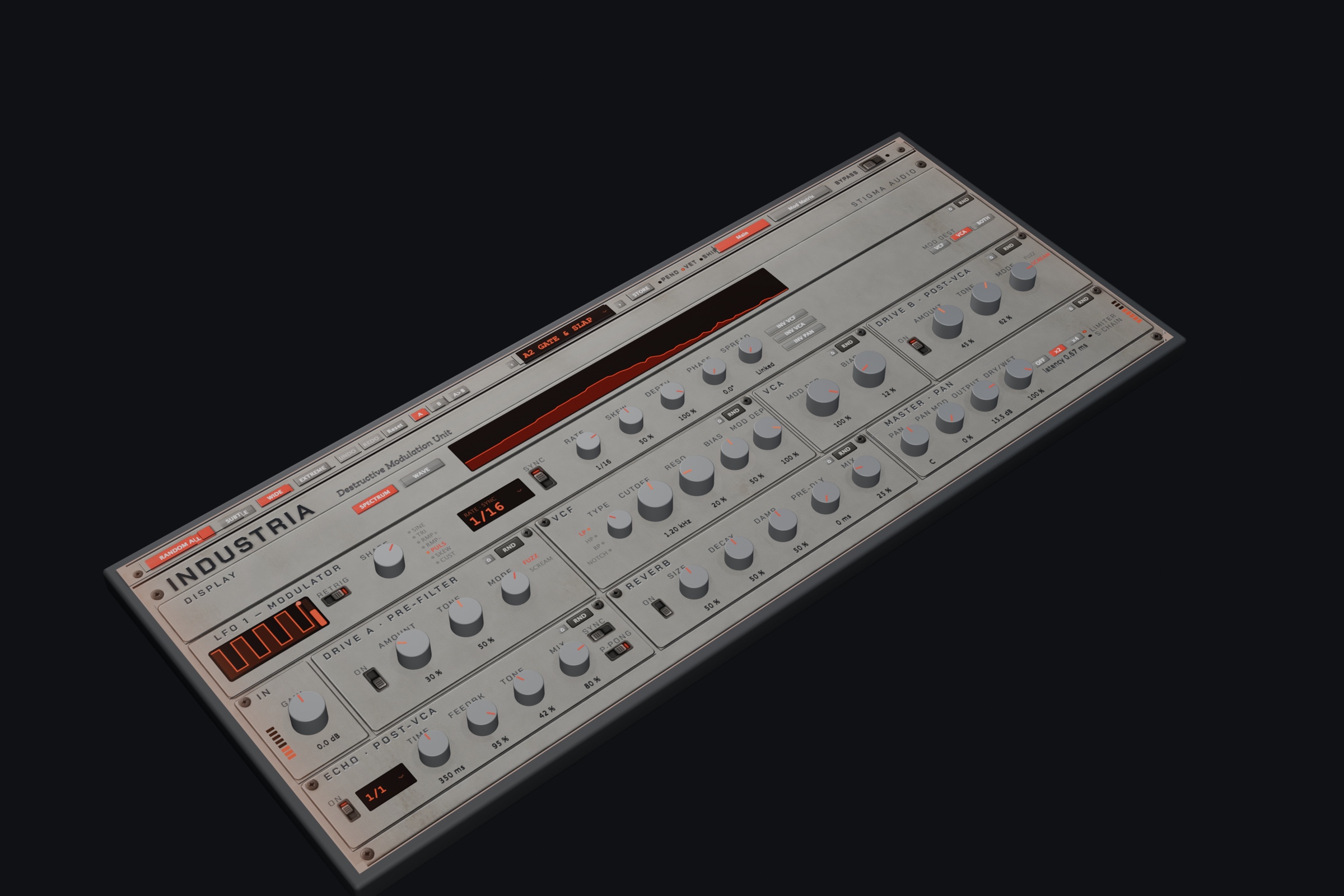
On screen
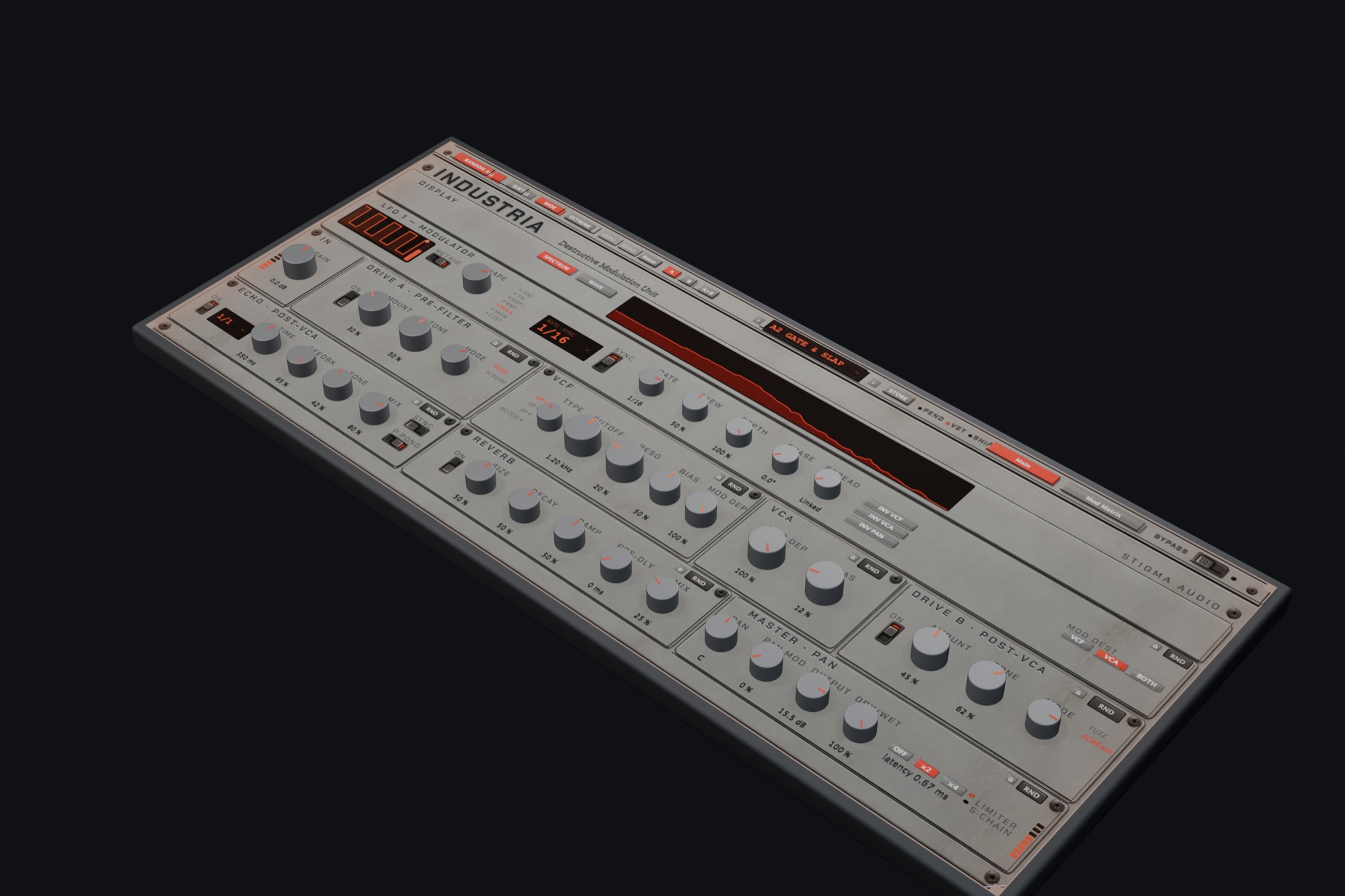
The real thing, full size
A straight screenshot of the plugin, running — no render, no retouching.
The principle
One LFO. Two targets. No mercy.
The founding circuit
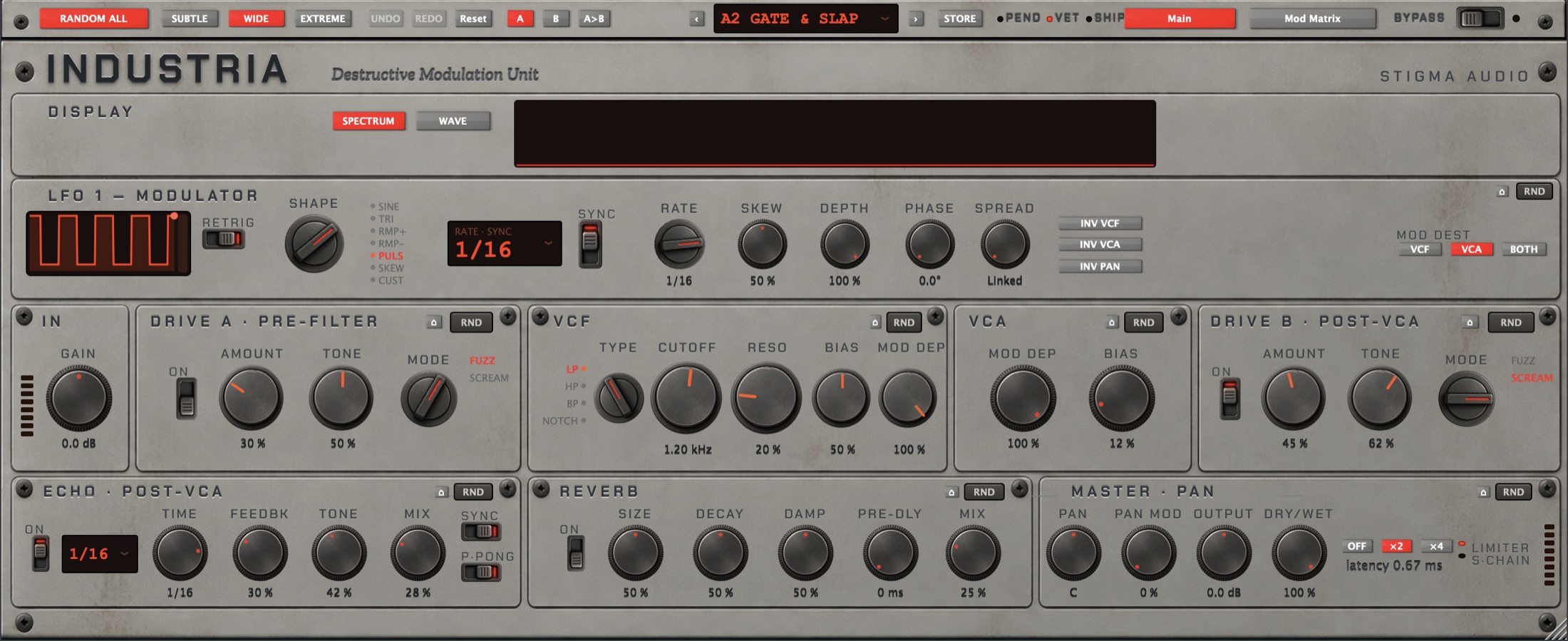
One LFO drives the filter and the amplitude at the same time — VCF, VCA or both, with per-destination polarity inversion so one opens while the other closes.
Shape the motion yourself
Seven LFO shapes, including a hand-drawn 16-step table: stepped, it's a sequencer; interpolated, it's a free curve. Free-running or locked to the host grid.
Then patch the matrix
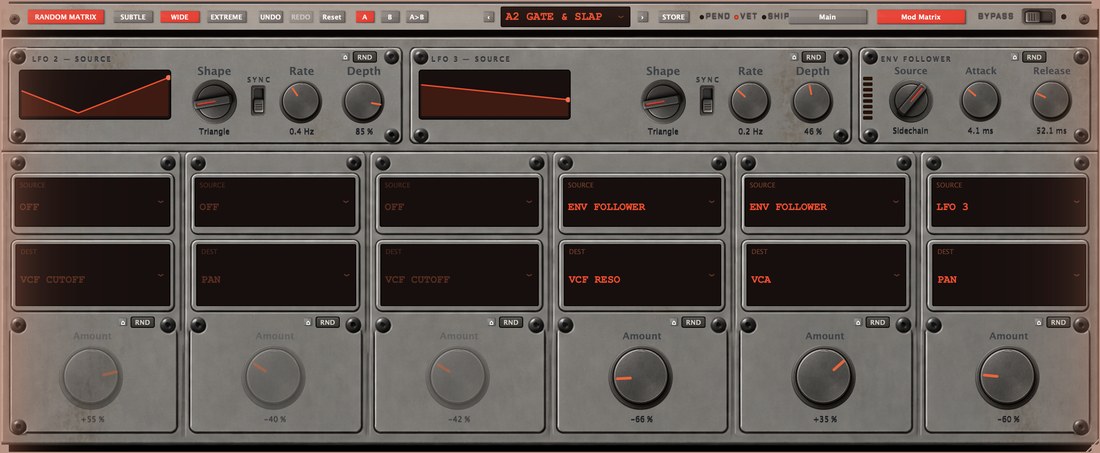
Three LFOs and an envelope follower feed six bipolar slots. A modulator can modulate another modulator — including its own rate.
The machine
A rack, not a screen of menus
The Main page is for playing; the Mod Matrix page is for wiring. Everything else lives on one metal facade.
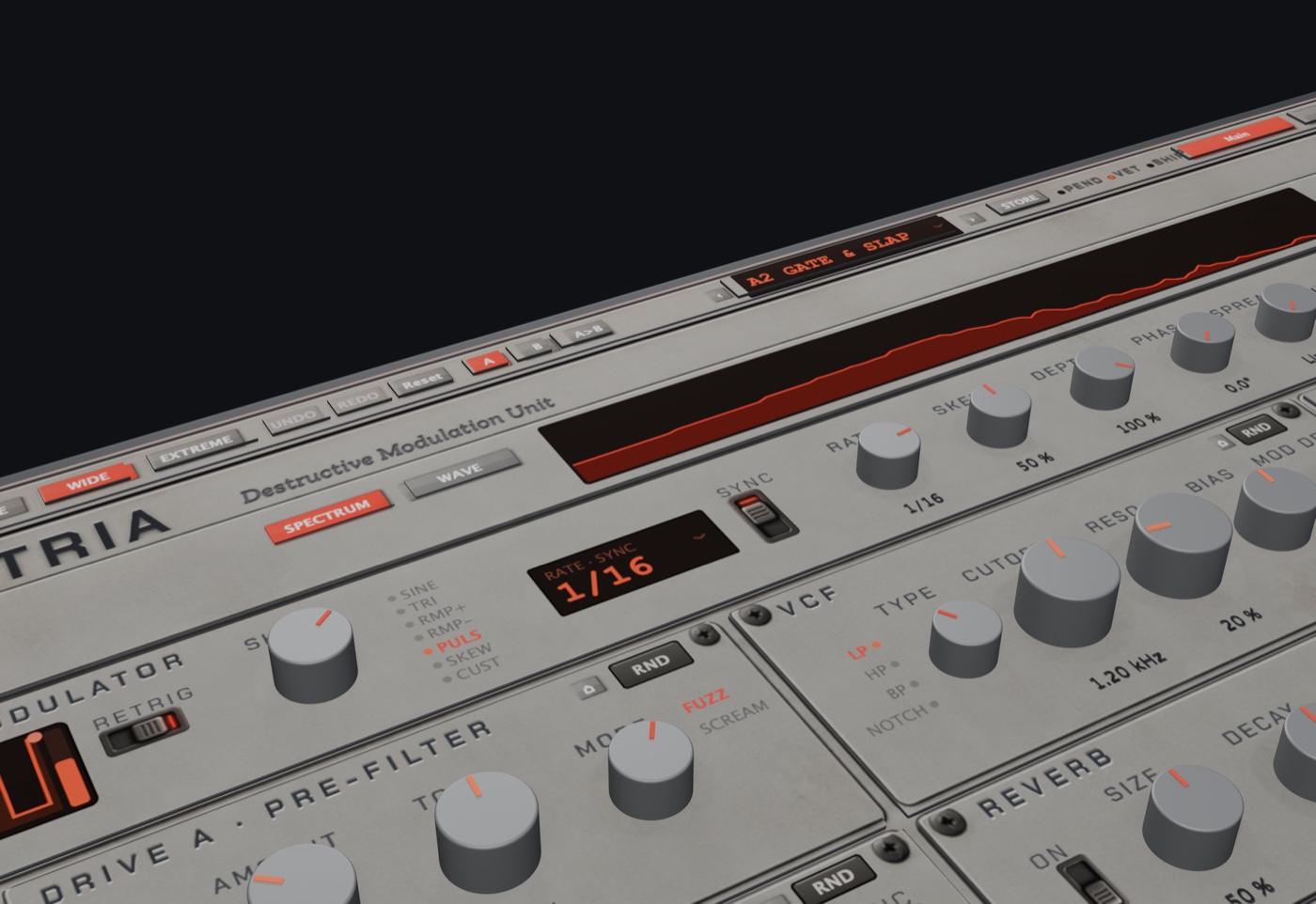
The modulator
Rate, skew, depth, phase and stereo spread — plus INV VCF / VCA / PAN and the VCF · VCA · Both routing.
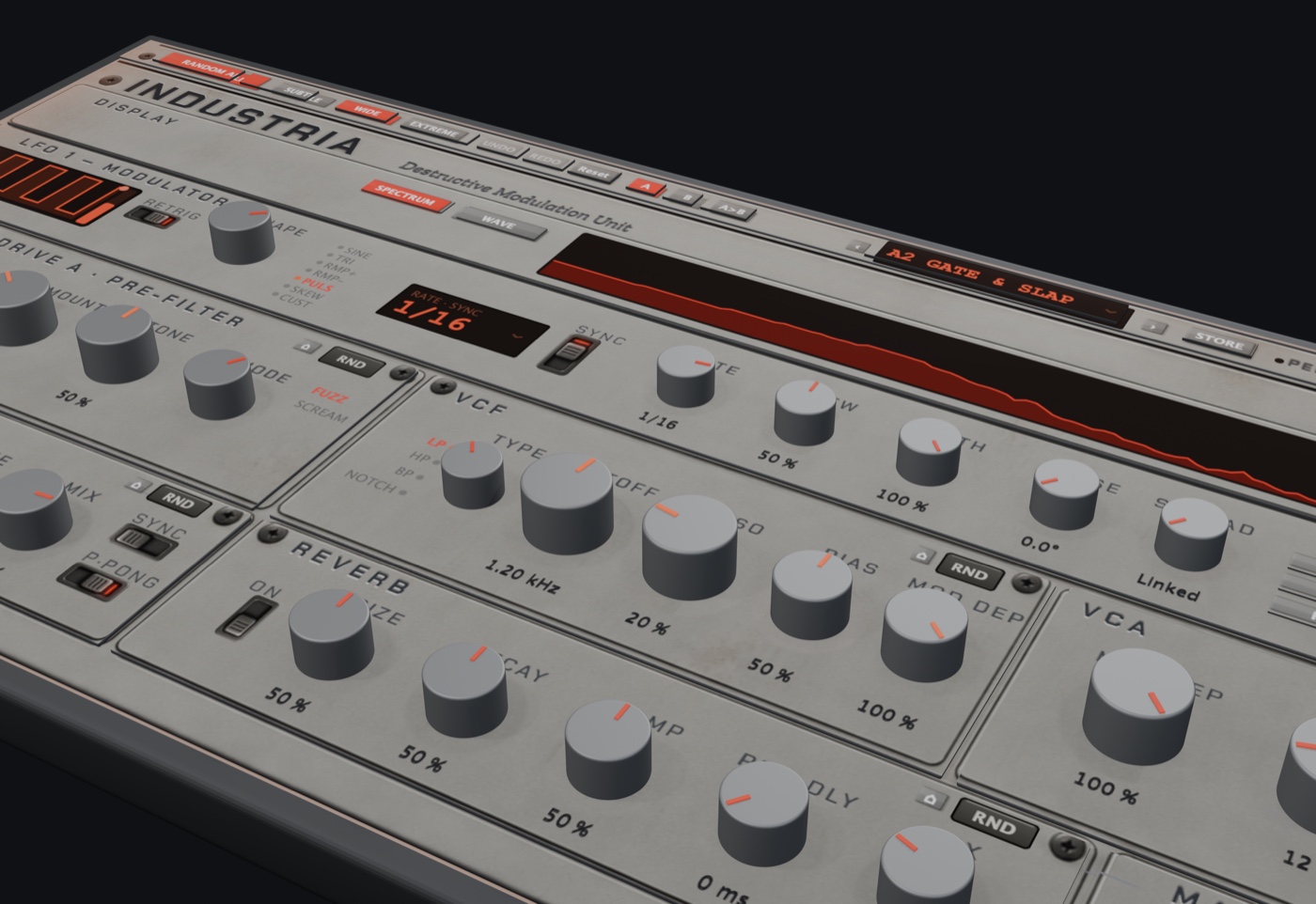
The destruction row
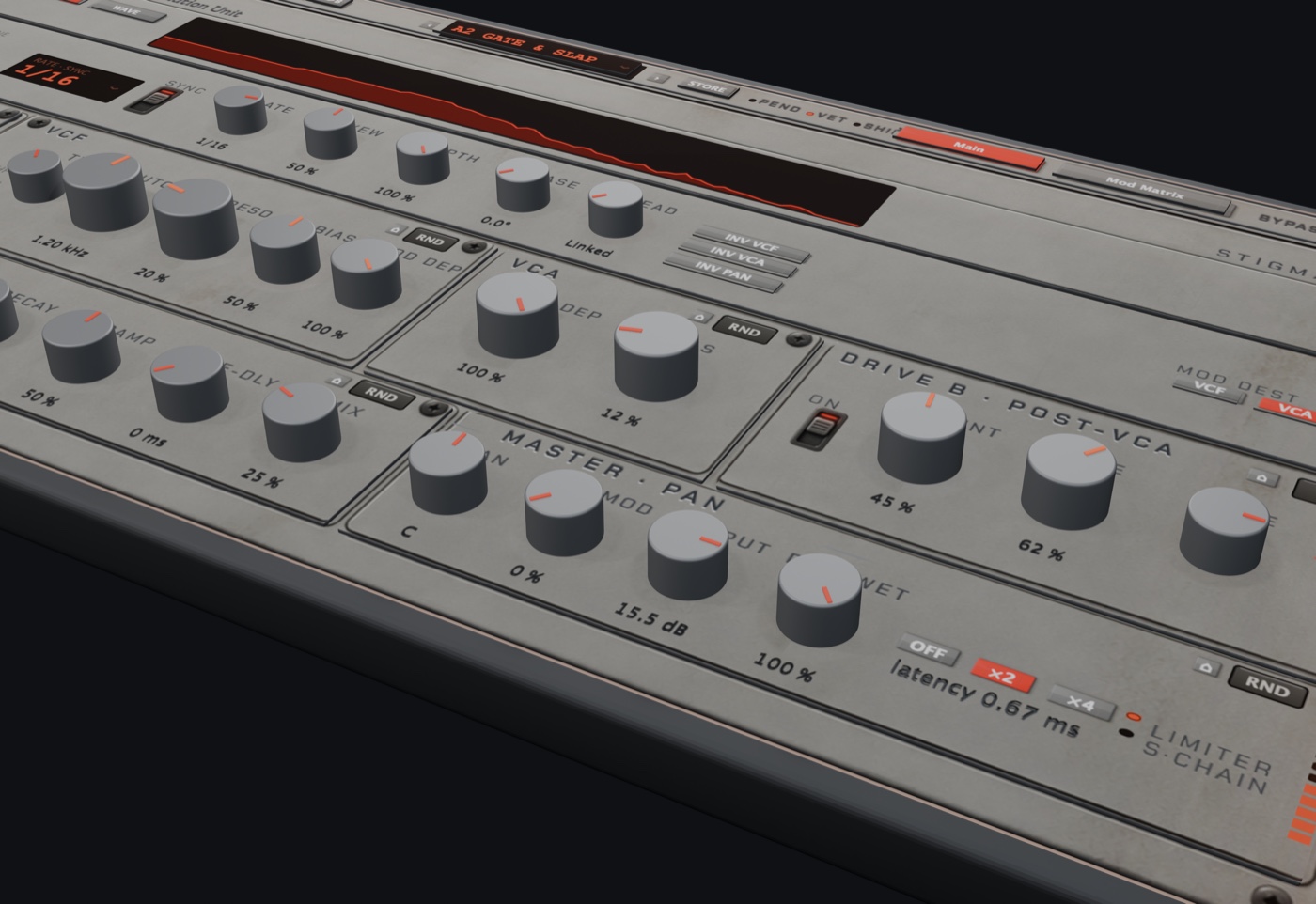
Drive A before the filter, Drive B after the VCA — asymmetric saturation, Fuzz and Scream — around a resonant multimode VCF.
The tail section
Tempo-synced echo with ping-pong and filtered feedback, a dark reverb, and a pan that moves with the LFO.
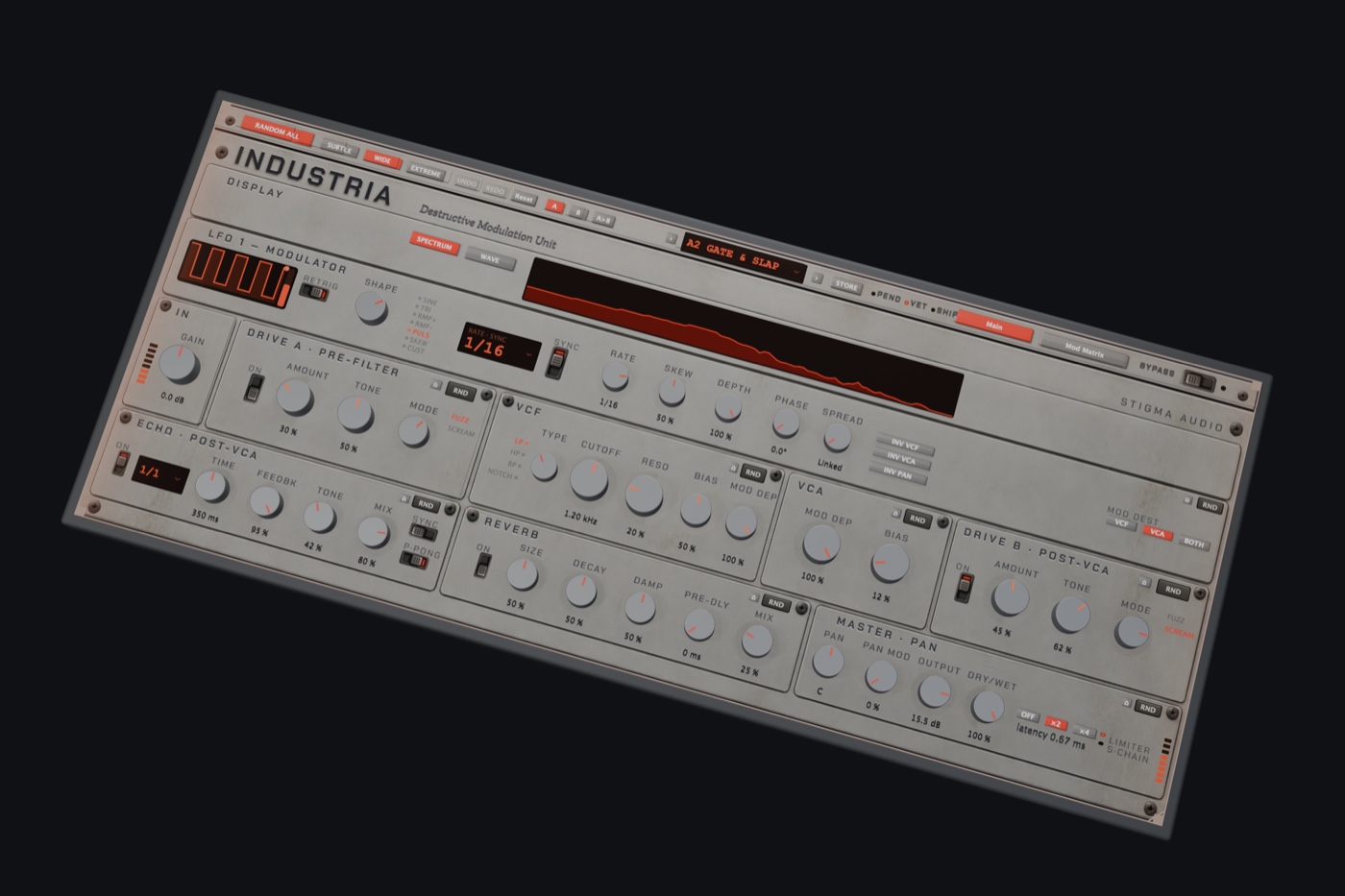
The whole rack
Spectrum and waveform display, per-bay RND buttons with locks, and a safety limiter at the end so you can go as far as you want.
In motion
Take a closer look
A 3D pass over the facade — the modulator, the destruction row, the tail section. One machine.
Signal chain
IN → out, the long way
IN → Drive A → VCF → VCA → Drive B → Echo → Reverb → Pan → OUT, with a safety limiter and dry/wet at the end.
DRIVE A · B
Two independent saturation stages, before the filter and after the VCA. Asymmetric waveshaping, Fuzz and Scream characters, amount and tone.
VCF
State-variable resonant filter — LP, HP, BP, Notch — cutoff swept by the modulators, per-sample.
VCA
The bias knob sets what survives between two pulses: from a discreet tremolo to a brutal gate.
ECHO
Synced or free, ping-pong, tone and saturation in the feedback loop — bounded so it never runs away.
REVERB
Size, decay, damping, pre-delay — a room that can swallow the whole chain.
PAN
A static position plus LFO movement around it: off-center auto-pan the host's pan can't do.
SIDECHAIN
Feed another signal in: amplitude-follow it, or ring-modulate against it.
LIMITER
A safety net at the very end — push everything, keep your monitors.
Page two
The Mod Matrix
Flip the tab and the rack turns into a patchbay: LFO 2, LFO 3 and the envelope follower on top, six source → destination slots below — with its own RANDOM MATRIX button.
Controlled accidents
Randomness with intent
- RANDOM ALL — plus a Random button and a lock on every bay: keep your echo, reroll the rest.
- Three intensities: Subtle, Wide, Extreme.
- Undo, Redo, A/B: explore without risk, compare without faith.
- Oversampling ×2 / ×4 on the drive stages only — where it counts.
Specifications
Under the hood
Launch
Get notified when it ships
No spam: one email at release. That’s it.
Opens our Gumroad page — type your email there, done. Unsubscribe in one click, any time.
A STIGMA AUDIO PLUGIN · 2 DRIVES · 3 LFOS · 1 MATRIX